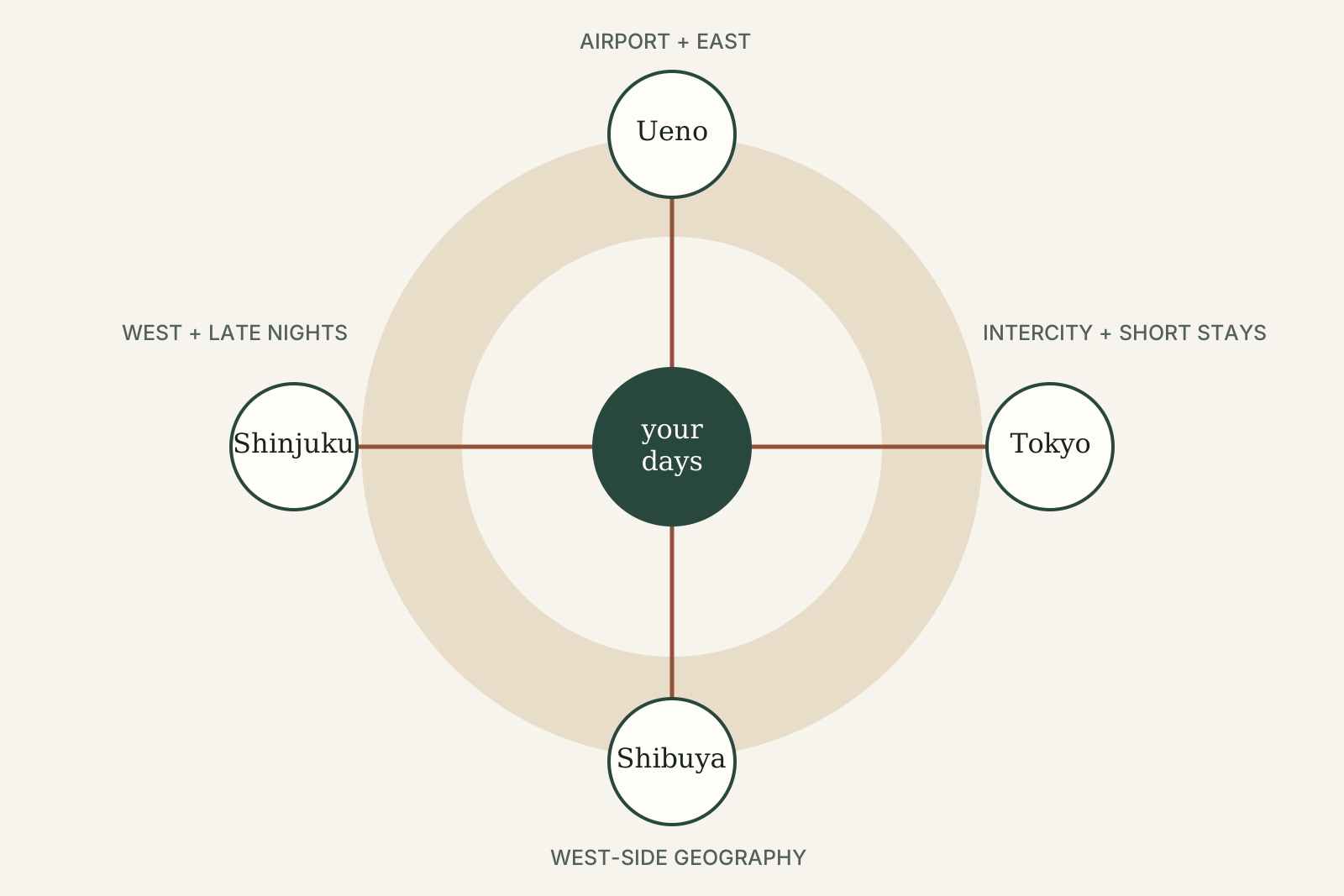
Tokyo rewards a precise hotel question. “Near Shinjuku” can describe opposite sides of a vast terminal. “By Tokyo Station” can mean the palace-facing Marunouchi side, the Yaesu side, or a hotel whose nearest entrance is useful for a line you never take.
The best base is not necessarily the station with the most lines. It is the address that makes your repeated journeys simple. A five-minute walk to the correct entrance often beats a one-minute walk to the wrong side of a terminal.
Audit the door-to-platform journey
Start with three journeys you expect to make more than once: perhaps Shibuya and Omotesando, the museums around Ueno, and an early Shinkansen. For each, identify the operator and line rather than writing only the station name.
Then inspect the exact hotel address and the official station map. Look for the nearest named entrance or ticket gate, the floor of the platform, and whether changing lines means crossing the paid area or walking between separate stations.
Published train time is only the middle of the journey. JR East’s standard transfer allowances at Tokyo Station range from 10 minutes between some Shinkansen and conventional lines to 20 minutes for the Keiyo Line. At Ueno, the published allowance between the Shinkansen and Tokyo Metro is 22 minutes. Those are transfer standards, not hotel-walking estimates, but they show why “three minutes from the station” is incomplete.
Tokyo Station: choose the side, not just the name
Tokyo Station is persuasive for a short, rail-heavy stay. Tokaido Shinkansen services depart for Kyoto and Osaka; JR East Shinkansen run north and east; conventional lines include the Yamanote, Chuo, Keihin-Tohoku, Ueno-Tokyo, Sobu/Yokosuka, and the deep Keiyo platforms. The Narita Express also serves the station.
The tradeoff sits inside the complex. Marunouchi, on the west, faces the Imperial Palace side. Yaesu and Nihombashi are east and northeast, toward Ginza and Nihombashi. A hotel convenient for the Nihombashi Gate may be excellent for a Shinkansen but less immediate for a palace-side morning. A hotel advertised for the Marunouchi Line may still be a long indoor walk from another JR platform.
Choose this pattern for an early intercity departure, a brief first visit with plans on both sides of the city, or an arrival where one direct rail journey matters more than a strong late-night neighborhood. Before booking, trace the route from the hotel door to the platform you will actually use.
Ueno and Okachimachi: useful for the east and Narita
Ueno works especially well when the itinerary leans east: Ueno Park and its museums, Asakusa, Yanaka, and the market streets around Ameyoko. JR services include the Yamanote and Keihin-Tohoku lines, several regional lines, and Shinkansen heading north and east. Tokyo Metro’s Ginza and Hibiya lines broaden the reach.
Keisei-Ueno also gives this area a strong Narita argument: the operator currently advertises its fastest Skyliner journey from Narita Airport Terminal 2·3 at 41 minutes. That figure is train time, not a promise from aircraft door to hotel, and Keisei-Ueno, JR Ueno, and Metro Ueno are related stations rather than one compact interchange.
Okachimachi can be a calmer edge of the same pattern while retaining Yamanote access. Asakusa gives up Ueno’s JR network but offers a more immediate neighborhood choice for travelers who expect to spend their evenings there. This base is less convincing for repeated late nights in Shibuya or Shinjuku.
Shinjuku and Yoyogi: stay on the side you will use
Shinjuku is a transport district as much as a station. JR lines connect it with Tokyo Station, Shibuya, the Chuo corridor, Narita Airport, and destinations reached by limited express. The wider complex adds Tokyo Metro, Toei, Keio, and Odakyu services.
That breadth is the benefit and the warning. East, west, and south Shinjuku behave like different bases. A west-side hotel can suit an Odakyu departure or the business district; an east-side address puts evening streets closer; the south side may work better for particular JR gates and bus connections. The station spans multiple levels and 16 conventional JR track numbers.
Choose Shinjuku for a west-Tokyo itinerary, late evenings nearby, or onward plans using Odakyu or the Chuo line. Consider Yoyogi or Shinjuku-sanchome when their direct lines fit: a smaller-feeling station can be operationally easier than living beside a famous terminal.
Shibuya and Ebisu: optimize for the west
Shibuya is the right answer when much of the trip sits in Shibuya, Harajuku, Omotesando, Daikanyama, and the western nightlife and dining districts. JR, Tokyu, Keio, and Tokyo Metro lines create excellent reach in several directions; nearby areas are also walkable when the weather and energy cooperate.
It is not frictionless. Platforms are distributed above and below ground, and the official tourism guide explicitly warns that the convergence of lines can be disorienting. A hotel close to one operator may be awkward for another. Check the station exit and vertical route, particularly if luggage, steps, or long corridors matter.
Ebisu is the quieter variant. It retains Yamanote and Hibiya access and keeps west-side geography strong, but it is not trying to be the universal center of Tokyo. Both bases are weaker for repeated Ueno and Asakusa days or a Tokaido Shinkansen departure that requires a transfer.
Match the base to the itinerary
Use a small matrix rather than ranking neighborhoods:
| Base pattern | Makes easier | Gives up |
|---|---|---|
| Tokyo Station | Intercity rail, mixed east/west days, short stays | A compact neighborhood feel; simple access to every platform |
| Ueno/Okachimachi | Narita, museums, Asakusa and east Tokyo | Late west-side returns |
| Shinjuku/Yoyogi | West Tokyo, Chuo/Odakyu plans, nightlife | A simple terminal unless the correct side is chosen |
| Shibuya/Ebisu | Western neighborhoods, walking between nearby districts | Direct access to eastern sights and Tokaido Shinkansen |
The winner should emerge from the days you have planned, not from a universal list. Once you have a base pattern, compare exact hotels by entrance, room, and terms. In Tokyo, the final 500 meters can matter as much as the line on the map.
Sources & verification
These sources support the factual details. Check the linked provider for current arrangements before booking.
- JR East — Tokyo Station map and transfer timesChecked
Platforms, exits, and standard transfer allowances.
- JR East — Ueno Station map and transfer timesChecked
Platforms and the published Shinkansen-to-subway transfer allowance.
- JR East — Shinjuku Station mapChecked
JR lines, platform levels, and station layout.
- Tokyo Metro — Shibuya StationChecked
Lines, operators, exits, and accessibility information.
- GO TOKYO — Ueno guideChecked
Official area geography and major visitor anchors.
- GO TOKYO — Shibuya walking guideChecked
Official context on the above- and below-ground station complex.
- Keisei — Skyliner access to UenoChecked
Current Narita–Keisei-Ueno service description.