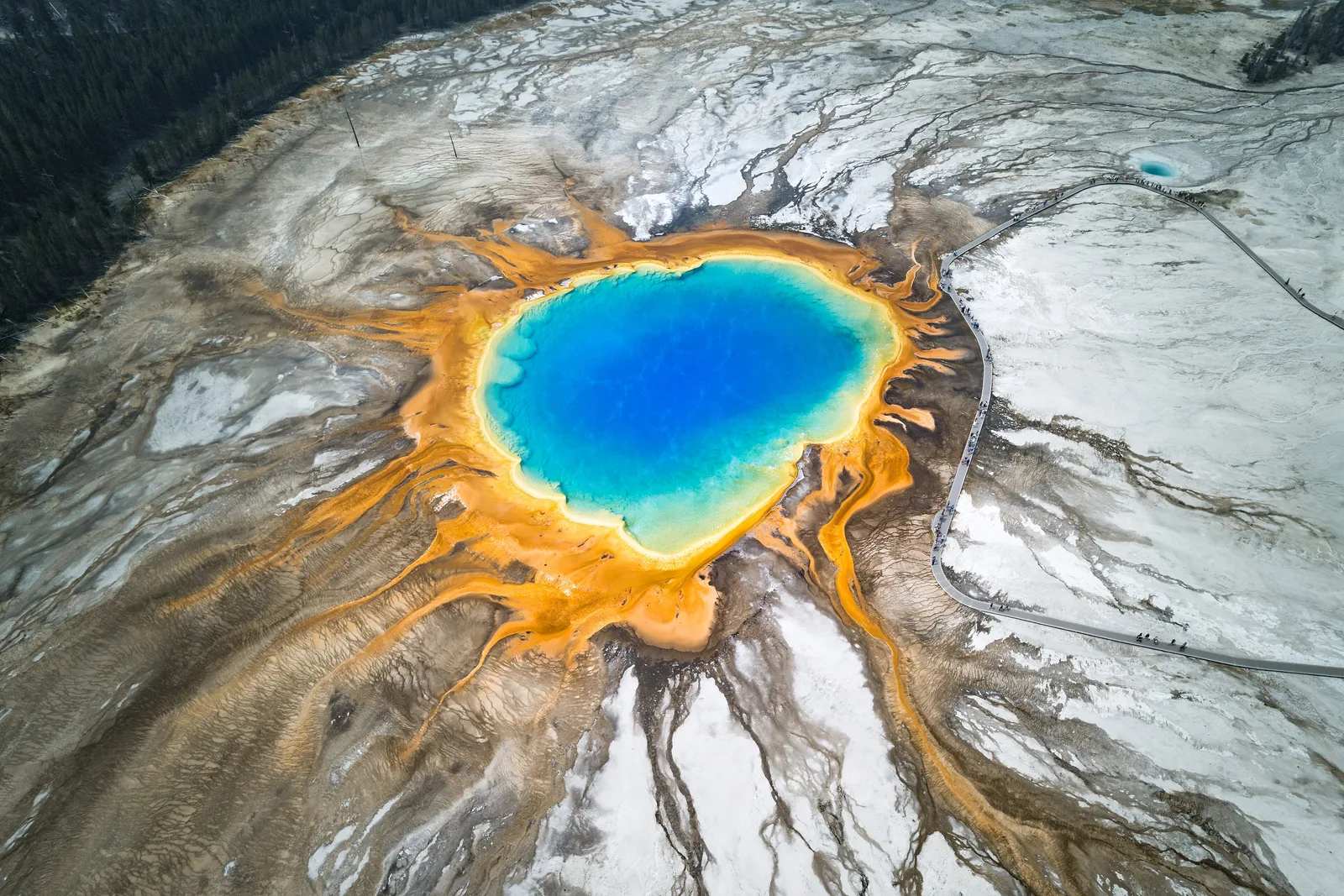

Yellowstone is a loop on a map and several different destinations on the ground. Old Faithful, the Grand Canyon of the Yellowstone, Yellowstone Lake, Mammoth, and the northern range are separated by roads where wildlife, construction, weather, and parking can overrule an average.
A split stay can reduce scheduled backtracking. It cannot remove the park’s uncertainty. The useful plan is one that shortens the drives you choose before leaving space for the delays you cannot.
Read the park in touring zones
The National Park Service publishes average segment times between major junctions. Add them to understand the shape of a day, but do not treat the total as a promise.
For example, West Entrance to Madison averages 30 minutes and Madison to Old Faithful 35–45 minutes. That makes West Yellowstone to Old Faithful roughly 65–75 minutes before a wildlife jam, a parking search, or a stop you did not expect to make.
Old Faithful to Grant Village averages 40 minutes; Grant to Lake Village another 45; Lake to Canyon 35. The south-and-east arc from Old Faithful to Canyon is therefore about two hours of base driving before sightseeing. Going through Madison and Norris is roughly 95–105 minutes by the same arithmetic.
The park becomes easier to plan as three zones:
- Southwest and geysers: Old Faithful inside the park, or West Yellowstone when outside-park choice matters.
- Canyon and lake: Canyon for the canyon, Norris, and the Tower direction; Lake for Yellowstone Lake, West Thumb, and a south/east approach.
- North: Mammoth and Gardiner, with more seasonal options toward Roosevelt and Cooke City, for Mammoth and northern-range priorities.
The two-base first-visit split
For four nights, two southwest and two Canyon/Lake nights form a clean first-visit pattern. The first base keeps repeated geyser-basin driving down. The second puts the canyon and lake within a more useful orbit.
Make the hotel move a touring day. One version follows Old Faithful to West Thumb/Grant, continues along the lake, and ends at Canyon or Lake. The NPS segment averages—40 minutes, 45 minutes, then 35 minutes to Canyon—show that this is a full day with stops, not a quick relocation.
The direction of arrival and departure matters. A traveler entering from the west and leaving toward the south may prefer Lake over Canyon for the second phase. Someone continuing north can use Canyon as a step toward Mammoth. Choose the split to avoid undoing the same road the next morning.
When a third base earns the packing
With five or six nights, one or two nights in the north can reduce the commute to Mammoth and northern-range days. The NPS average between Mammoth and Canyon is about 75 minutes via Norris, or roughly 90–100 minutes via Tower, before delays.
The third base earns its place for travelers who want more than one early or late northern-range outing, or whose route naturally exits north. It does not guarantee wildlife, and it can be poor value for someone who dislikes packing or needs an accessible room that was difficult to secure.
For three nights, use caution. Two southwest nights and one Canyon/Lake night can work when the arrival and departure directions support it. Otherwise the hotel change may consume too much of a short visit. A single base with longer drives can be the more comfortable compromise.
Compare inside and outside the park honestly
An in-park base can reduce approach driving and make an early start easier, but inventory is seasonal and reservations often fill well ahead. Room style, connectivity, food choice, and cancellation terms vary. Outside-park towns may offer more options, but “at the entrance” is not the same as “at the attraction.”
West Yellowstone still sits beyond the 30-minute West Entrance–Madison segment. Gardiner is useful for Mammoth but does not make Old Faithful close. No outside base is central to the whole park.
Use the same hotel test as elsewhere: exact room, meal logistics, cancellation terms, and the first road you need in the morning. In a park this large, the room and the route are one decision.
Check the live park before every phase
NPS calls its road-opening dates projected and weather-dependent. The North Entrance–Northeast Entrance road is generally the only regular-vehicle corridor open year-round; most other park roads close to wheeled vehicles through winter. Facility seasons do not always match road seasons.
Before committing to a split, check:
- live road status and construction;
- projected opening and closing dates for each segment;
- lodging and dining operating dates at both bases;
- whether a transfer-day route is actually open;
- a fallback if weather changes the ambitious day.
Do not freeze a construction delay or opening date into the itinerary months ahead. The live NPS road page is the source of truth near travel.
The aim is not to conquer the loop efficiently. It is to spend less of the visit repeating long approach roads and more of it close to the landscapes you came to see. Two well-chosen bases often do that better than one supposedly central pin.
Sources & verification
These sources support the factual details. Check the linked provider for current arrangements before booking.
- NPS — Yellowstone directions and drive timesChecked
Official average times between major junctions and entrances.
- NPS — park roads and live statusChecked
Current road status, construction, seasonal access, and weather caveats.
- NPS — operating datesChecked
Projected road and facility seasons, all subject to conditions.
- NPS — lodgingChecked
In-park lodging locations, facilities, and reservation guidance.